Lab-Grown vs Mined Diamonds: The 2026 Buyer's Guide
Lab-grown diamonds now account for nearly half of all engagement ring center stones sold in the U.S. Here's an honest, data-driven comparison to help you decide which is right for you.
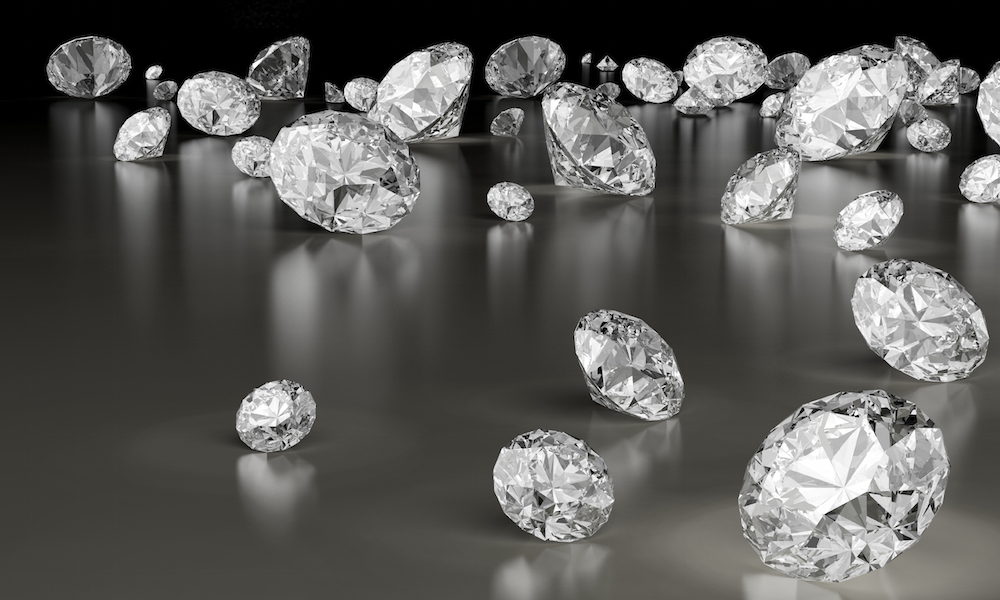
What Are Lab-Grown Diamonds?
Lab-grown diamonds are real diamonds created in controlled laboratory environments using advanced technology that replicates the conditions under which diamonds form naturally. There are two primary methods of production:
- HPHT (High Pressure High Temperature) -- mimics the extreme heat and pressure found 100 miles below Earth's surface. A small diamond seed is placed in a chamber with a carbon source and subjected to temperatures above 2,700°F and pressures over 1.5 million pounds per square inch.
- CVD (Chemical Vapor Deposition) -- a diamond seed is placed in a vacuum chamber filled with carbon-rich gas (typically methane). The gas is ionized into plasma, and carbon atoms deposit onto the seed layer by layer, growing a diamond crystal over several weeks.
Both methods produce diamonds that are atomically identical to those formed over billions of years deep in the Earth's mantle. The result is a stone with the same crystal structure, hardness, brilliance, and fire as any mined diamond.
Physical and Chemical Comparison
This is where things get straightforward: lab-grown and mined diamonds are identical in every way that matters for jewelry. Here's the side-by-side breakdown:
| Property | Mined Diamond | Lab-Grown Diamond |
|---|---|---|
| Chemical Composition | Pure carbon (C) | Pure carbon (C) |
| Crystal Structure | Cubic (isometric) | Cubic (isometric) |
| Hardness (Mohs Scale) | 10 | 10 |
| Refractive Index | 2.42 | 2.42 |
| Dispersion | 0.044 | 0.044 |
| Density | 3.52 g/cm³ | 3.52 g/cm³ |
| Thermal Conductivity | ~2200 W/mK | ~2200 W/mK |
| Detectable Difference | Only with specialized lab equipment analyzing trace elements and growth patterns | |
A standard diamond tester will confirm both as diamond. A jeweler's loupe and microscope cannot distinguish between them. Even GIA gemologists require specialized spectroscopy equipment to identify the origin of a diamond.
At Diamonds Above in Austin, we regularly show clients both types side by side. Without being told which is which, no one has ever been able to tell them apart. The sparkle, fire, and brilliance are indistinguishable.
Price Comparison: 2026 Numbers
The price difference between lab-grown and mined diamonds is significant and has widened in recent years as lab-grown production has scaled up. The clearest way to see the gap is to look at what the same budget buys at the same premium grade. Here is our Austin showroom pricing for loose stones at D–F color, VS1–VVS1 clarity, Excellent cut (any shape):
| Budget (loose stone) | Lab-Grown Size You Can Get | Natural Size You Can Get |
|---|---|---|
| $975 – $1,250 | 1.00 ct | ~1/3 ct |
| $1,750 – $2,350 | 2.00 ct | ~1/2 ct |
| $2,950 – $3,750 | 3.00 ct | ~0.75–0.85 ct |
| $4,300 – $4,950 | 4.00 ct | ~0.90–0.95 ct |
| $5,500 – $8,500 | 5.00 ct | ~1.00–1.25 ct |
Mountings are separate: expect $1,200–$2,800 for a lab-grown pairing or $1,700–$4,500 for a natural-paired setting, depending on gold weight, pavé sides, and hidden-halo detailing.
Put plainly: at roughly $2,000, you can have a 2-carat lab-grown stone or about a 1/2-carat natural of the same premium grade. That's a dramatic difference in how the ring reads on a finger.
Why Are Lab-Grown Diamonds So Much Cheaper?
The cost difference comes down to supply economics. Mining diamonds requires massive infrastructure -- exploration, excavation, processing, and transportation across global supply chains. Lab-grown diamonds are produced in factories with decreasing production costs as technology improves. There's no scarcity constraint, which means prices are driven by production cost rather than controlled supply.
Certification and Grading
Both lab-grown and mined diamonds are graded using the same 4 C's system (Cut, Color, Clarity, Carat) by the same leading gemological laboratories:
- GIA (Gemological Institute of America) -- the gold standard in diamond grading. GIA issues full grading reports for lab-grown diamonds with the same level of detail as their natural diamond reports.
- IGI (International Gemological Institute) -- the most popular lab for grading lab-grown diamonds, known for detailed reports and competitive pricing.
- AGS (American Gem Society) -- highly respected for their cut grading system, particularly for round brilliants.
Every diamond sold at Diamonds Above, whether lab-grown or natural, comes with certification from a reputable laboratory. We recommend GIA or IGI certification for both types. The certificate provides an objective, third-party assessment of the diamond's quality that you can trust.
Lab-grown diamonds are always clearly identified as laboratory-grown on their certificates. Most are also laser-inscribed on the girdle with a report number and the designation "LG" or "Laboratory Grown" -- visible only under magnification.
Resale Value: The Honest Truth
This is the topic where we see the most confusion and misinformation, so let's be direct.
Mined diamonds typically resell for 30-50% of their original retail purchase price, depending on the stone's quality, current market conditions, and where you sell. The diamond market has historically been stable but is not an investment vehicle.
Lab-grown diamonds currently resell for approximately 20-30% of their original purchase price. As production continues to scale and prices drop for new stones, the resale market for pre-owned lab-grown diamonds faces downward pressure.
Putting Resale in Perspective
Here's a comparison that puts the resale difference in practical terms:
- You buy a 1-carat mined diamond for $5,500. You later sell it for $2,200 (40% resale). Your net cost: $3,300.
- You buy a 1-carat lab-grown diamond for $1,200. You later sell it for $300 (25% resale). Your net cost: $900.
Even though the resale percentage is lower for lab-grown, the total dollar loss is significantly less because you paid less upfront. And most importantly: the overwhelming majority of engagement ring diamonds are never resold. They're worn and cherished for a lifetime, or passed down through generations.
At Diamonds Above, we believe in giving you all the facts and letting you make the choice that fits your values and budget. We never push one option over the other.
Environmental and Ethical Considerations
Environmental Impact
The environmental comparison is nuanced. Diamond mining disrupts land, uses significant water resources, and has historically been associated with habitat destruction. Modern mining operations have improved their environmental practices considerably, but the footprint remains significant.
Lab-grown diamond production requires substantial energy, particularly the HPHT method. However, many producers have transitioned to renewable energy sources. CVD production is generally less energy-intensive. The carbon footprint of a lab-grown diamond is estimated to be significantly lower than that of a mined diamond when renewable energy is used.
Neither option is perfectly "green," but for buyers who prioritize environmental considerations, lab-grown diamonds produced with renewable energy offer the smaller footprint.
Ethical Considerations
The diamond mining industry has made progress since the implementation of the Kimberley Process in 2003, which was designed to prevent conflict diamonds from entering the legitimate market. However, concerns about labor practices, community displacement, and the limitations of the Kimberley Process persist.
Lab-grown diamonds eliminate supply chain uncertainty entirely. You know exactly where and how the diamond was produced. For buyers who want complete confidence in the ethical origin of their stone, lab-grown provides that peace of mind.
Want to See Both Side by Side?
Compare lab-grown and natural diamonds in person with unbiased expert guidance.
See Both Side by Side
The best way to compare is in person. Visit our Austin showroom and we'll show you lab-grown and natural diamonds of the same specs so you can see for yourself.
Which Is Right for You?
There's no universally correct answer. Here's a framework our gemologists at Diamonds Above use to help Austin couples decide:
Choose a Mined Diamond If...
- You value the romance of a stone formed over billions of years in the Earth
- Resale value and long-term market stability are important to you
- You prefer the tradition and heritage associated with natural diamonds
- You're purchasing a diamond as a potential heirloom or investment asset
Choose a Lab-Grown Diamond If...
- You want the largest, highest-quality diamond your budget allows
- Environmental and ethical sourcing are top priorities
- You'd rather invest the savings in the ring setting, wedding, or other priorities
- You care about the diamond's beauty and symbolism, not its geological origin
Many of our Austin clients end up choosing lab-grown for their engagement ring center stone and using the savings to upgrade to a more elaborate setting, add accent stones, or put money toward other goals. Others feel strongly about having a natural diamond and find tremendous meaning in its ancient origin story. Both choices are completely valid.
For a deeper dive into the qualities that matter most when selecting any diamond, see our expert guide to the 4 C's. If you're ready to start the engagement ring journey, our complete engagement ring guide walks you through every step of the process.
Frequently Asked Questions
Are lab-grown diamonds real diamonds?
Yes, lab-grown diamonds are real diamonds in every measurable way. They have the same chemical composition (pure carbon), crystal structure, hardness (10 on the Mohs scale), and optical properties as mined diamonds. The FTC confirmed in 2018 that lab-grown diamonds are diamonds. Professional gemologists cannot distinguish them without specialized equipment.
How much cheaper are lab-grown diamonds than mined diamonds?
Lab-grown diamonds typically cost 40-80% less than mined diamonds of equivalent quality. A 1-carat lab-grown diamond with Excellent cut, G color, and VS2 clarity might cost $800-1,500, while a comparable mined diamond could cost $4,000-6,000. The savings increase with larger carat weights.
Do lab-grown diamonds hold their value?
Lab-grown diamonds have lower resale percentages than mined diamonds, typically reselling for 20-30% of their original purchase price. Mined diamonds generally resell for 30-50% of retail. However, because lab-grown diamonds cost significantly less upfront, the total dollar loss is often smaller. Most engagement ring diamonds are never resold regardless of origin.
Can a jeweler tell the difference between lab-grown and mined diamonds?
A jeweler cannot distinguish a lab-grown diamond from a mined diamond using standard tools like a loupe or microscope. Specialized screening equipment that detects differences in trace elements and growth patterns is required. Both types are graded identically by GIA, IGI, and other certification labs.
Explore Your Options at Diamonds Above
At our Austin showroom, we carry an extensive selection of both natural diamonds and lab-grown diamonds in every shape, size, and quality range. Our gemologists will show you stones side by side, explain the differences in plain language, and help you make the decision that's right for your relationship and your budget.
Visit us at 4101 Guadalupe St, Suite 600, Austin, TX 78751 or . Call (512) 206-4156 -- we're here Tuesday through Thursday, 11 AM to 4 PM and Friday through Saturday, 11 AM to 3 PM.