The 4 C's of Diamonds: An Austin Jeweler's Expert Guide
Understanding Cut, Color, Clarity, and Carat is the single most important step to choosing a diamond you'll love for a lifetime. Here's everything our gemologists want you to know.
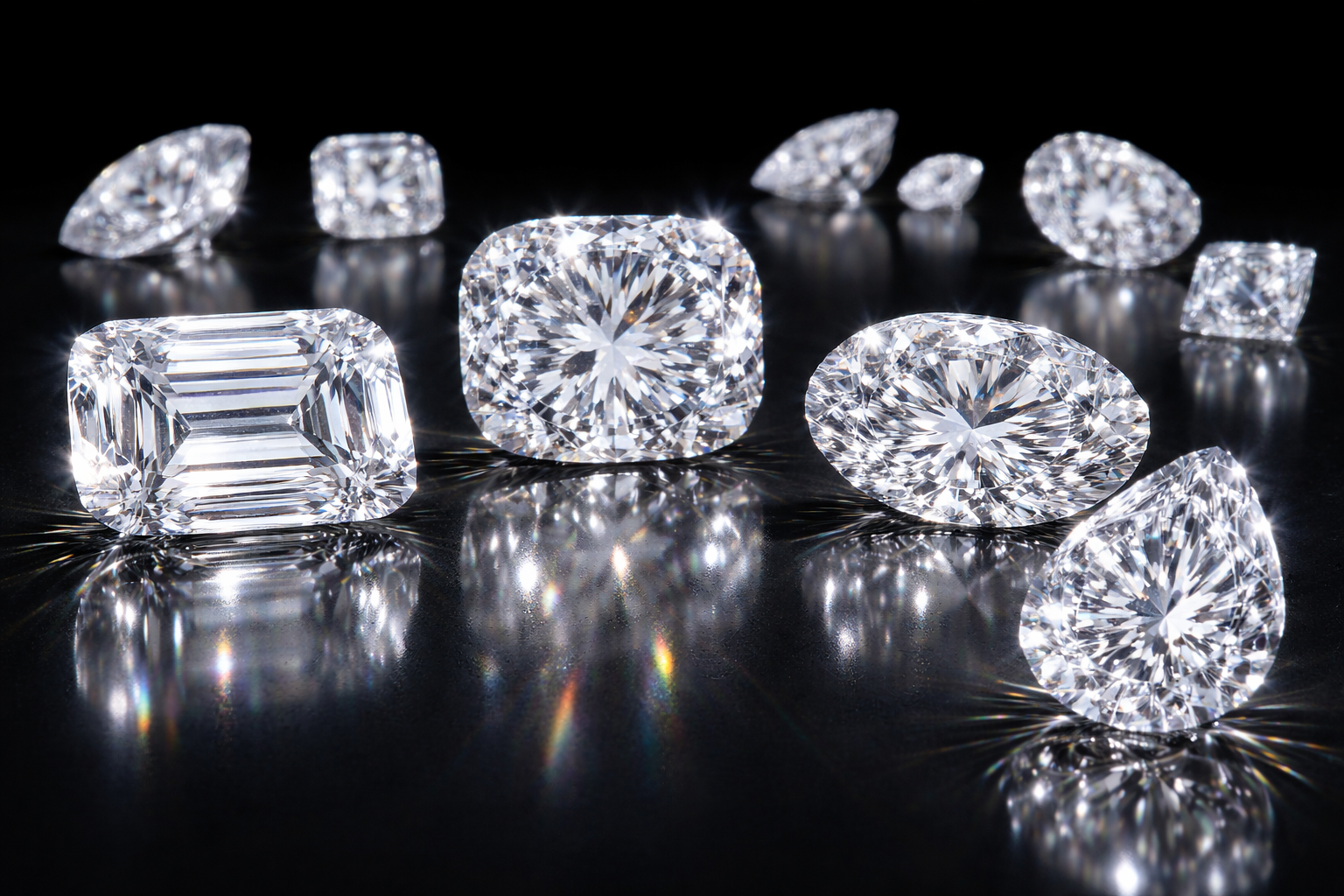
Why the 4 C's Matter
Every diamond is unique, and the 4 C's are the universal language that gemologists, jewelers, and certification labs use to describe and evaluate that uniqueness. Developed by the Gemological Institute of America (GIA) in the 1950s, this grading system transformed the diamond industry by giving buyers an objective way to compare stones.
When you walk into our Austin showroom at Diamonds Above, one of the first things we do is educate you on these four factors. Not because we want to overwhelm you with technical jargon, but because understanding the 4 C's empowers you to make a confident purchase and get the best possible diamond for your budget.
The 4 C's are: Cut (how well the diamond's facets interact with light), Color (how colorless the diamond appears), Clarity (the absence of internal inclusions and surface blemishes), and Carat (the diamond's weight). Each factor contributes to a diamond's beauty and value, but they don't all carry equal weight in terms of visual impact.
Cut: The Most Important C
If you remember only one thing from this guide, let it be this: cut is the single most important factor determining how beautiful a diamond looks. Cut refers not to a diamond's shape (round, oval, emerald, etc.) but to how precisely the stone's facets are angled and aligned to maximize light performance.
What Makes a Great Cut?
A well-cut diamond does three things exceptionally well:
- Brilliance -- the total amount of white light reflected back to your eye from inside and outside the diamond.
- Fire -- the dispersion of white light into spectral colors (those flashes of red, blue, and green you see when you move the stone).
- Scintillation -- the pattern of light and dark areas and the sparkle you see when the diamond, the light source, or your eye moves.
When a diamond is cut too shallow, light leaks out of the bottom. When it's cut too deep, light escapes through the sides. Only when the proportions are dialed in precisely does light enter through the top, bounce around the interior, and exit back through the top -- creating that breathtaking sparkle.
Cut Grade Scale
GIA grades cut on a five-point scale for round brilliant diamonds:
| Grade | Light Performance | Our Recommendation |
|---|---|---|
| Excellent | Maximum brilliance, fire, and scintillation | Best choice -- always recommend |
| Very Good | Slightly less light return than Excellent | Strong value option |
| Good | Noticeable light leakage | Budget-friendly but visible trade-off |
| Fair | Significant light loss | Not recommended for engagement rings |
| Poor | Dull, lifeless appearance | Avoid |
At Diamonds Above, we strongly recommend sticking with Excellent or Very Good cut grades. The difference in price between an Excellent and a Good cut is often modest compared to the dramatic difference in how the diamond looks on your finger.
A Note on Fancy Shapes
GIA only assigns cut grades to round brilliant diamonds. For fancy shapes like oval, cushion, pear, emerald, and marquise, you'll need to evaluate proportions, symmetry, and light performance using other criteria. Our gemologists in Austin can walk you through how to assess cut quality for any shape you're considering.
Color: The D-Z Scale Explained
Diamond color actually measures the absence of color. The most valuable colorless diamonds are graded D (completely colorless), and the scale runs down to Z (light yellow or brown tint). The differences between adjacent grades are extremely subtle -- even trained gemologists need controlled lighting and master stones to distinguish them.
Color Grade Ranges
| Grade Range | Category | What You'll See |
|---|---|---|
| D-F | Colorless | No color visible even under magnification |
| G-H | Near Colorless | Slight warmth only visible when compared side-by-side with D-F |
| I-J | Near Colorless | Faint warmth detectable face-up in larger stones |
| K-M | Faint | Noticeable warm tint |
| N-Z | Light | Obvious yellow or brown tint |
Our Expert Advice on Color
G and H color diamonds represent the best value for most buyers. These stones face up completely white in a ring setting, and the savings compared to D-F grades can be substantial -- often 15-30% less for an otherwise identical stone.
Here's a tip many jewelers won't tell you: the setting metal affects how color is perceived. If you're choosing a yellow gold or rose gold setting, you can comfortably drop to I or J color because the warm metal tone makes the slight tint in the diamond virtually invisible. For platinum or white gold, we recommend G-H for the cleanest look.
When you visit Diamonds Above in Austin, we'll show you stones across the color spectrum side by side so you can see for yourself where the differences become visible to your eye. Most clients are surprised at how far down the scale they can go without noticing any color.
Clarity: From Flawless to Included
Clarity measures the presence of internal characteristics (called inclusions) and surface characteristics (called blemishes). Almost every diamond has these -- they're the natural fingerprints formed during the diamond's creation billions of years ago, or in a matter of weeks for lab-grown diamonds.
The Clarity Scale
| Grade | Meaning | Visibility |
|---|---|---|
| FL | Flawless | No inclusions or blemishes under 10x magnification |
| IF | Internally Flawless | No inclusions under 10x magnification |
| VVS1-VVS2 | Very, Very Slightly Included | Inclusions extremely difficult to see at 10x |
| VS1-VS2 | Very Slightly Included | Minor inclusions visible at 10x but not to the naked eye |
| SI1-SI2 | Slightly Included | Inclusions noticeable at 10x; may be visible to naked eye in SI2 |
| I1-I3 | Included | Inclusions visible to the naked eye; can affect brilliance |
The "Eye-Clean" Sweet Spot
VS2 and SI1 clarity grades are where the smartest buyers shop. These diamonds have inclusions that can only be seen under magnification, meaning they look identical to a Flawless diamond when viewed without a loupe. The price difference between a VS2 and a VVS1 of the same carat, color, and cut can be 20-40%.
The key concept here is "eye-clean." An eye-clean diamond has no inclusions visible to the naked eye when viewed from a normal viewing distance (about 6-12 inches). At Diamonds Above, we hand-select every diamond and can guarantee which stones are genuinely eye-clean, regardless of what the certificate says. Some SI1 diamonds are perfectly clean to the eye; others have inclusions positioned right in the center of the table facet that you might notice. That's why buying from a knowledgeable jeweler who examines each stone individually matters so much.
Clarity Tips by Diamond Shape
Step-cut diamonds like emerald and Asscher cuts act as windows into the stone, making inclusions more visible. For these shapes, we recommend VS2 or higher. Brilliant cuts like round, oval, and cushion do a better job of hiding inclusions with their sparkle pattern, so SI1 can be an excellent choice.
Ready to See These Qualities in Person?
Our GIA-certified gemologists will walk you through each of the 4Cs with real diamonds in hand.
Carat: Size vs. Quality Trade-Offs
Carat is the unit of weight used for diamonds and gemstones. One carat equals 200 milligrams, or 0.2 grams. Carat weight is often confused with physical size, but they're not exactly the same thing -- two diamonds of the same carat weight can appear different sizes depending on their cut proportions and shape.
How Carat Weight Affects Price
Diamond prices don't increase linearly with carat weight. They jump at what the industry calls "magic numbers" -- 0.50, 0.75, 1.00, 1.50, and 2.00 carats. A 1.00-carat diamond can cost 20-40% more per carat than a 0.95-carat diamond, even though the size difference is nearly imperceptible to the eye.
Pro tip: Shopping just below these thresholds is one of the best value strategies in diamond buying. A 0.90-carat diamond looks virtually identical to a 1.00-carat stone on a finger, but the savings can be significant -- often $1,000 or more depending on the other quality factors.
Carat Weight and Diamond Shape
Different shapes carry their weight differently. Elongated shapes like oval, marquise, and pear tend to look larger per carat than round brilliants because more of their surface area is visible from the top (what gemologists call the "face-up" view). If maximizing visual size is your priority, these shapes offer excellent carat-per-dollar value.
Here's how different 1-carat diamonds compare in approximate face-up dimensions:
| Shape | Approximate Dimensions (mm) | Perceived Size |
|---|---|---|
| Round | 6.5 x 6.5 | Standard reference |
| Oval | 8.0 x 5.5 | Appears 10-15% larger |
| Pear | 8.5 x 5.5 | Appears 15-20% larger |
| Marquise | 10.0 x 5.0 | Appears 20-30% larger |
| Emerald | 7.0 x 5.0 | Appears similar |
| Cushion | 5.5 x 5.5 | Appears slightly smaller |
How to Balance the 4 C's on a Budget
Here's the framework our gemologists at Diamonds Above use when helping Austin clients maximize their diamond budget:
- Never compromise on cut. An Excellent or Very Good cut grade is non-negotiable. A well-cut 0.80-carat diamond will outshine a poorly cut 1.20-carat stone every time.
- Choose a color that's eye-white in your setting. G-H for white metals, I-J for warm metals. Save the D-E-F premium for those who truly want the rarest grade.
- Go eye-clean on clarity. VS2 or SI1 -- whichever gives you a stone that looks perfect without magnification. Let your jeweler verify this for you.
- Flex on carat weight last. After locking in cut, color, and clarity, see where your budget lands on carat weight. Shopping below magic numbers (0.90 instead of 1.00) stretches your dollar further.
This approach ensures the diamond on your partner's finger looks absolutely stunning to the naked eye -- which is how it's going to be seen 99.99% of the time.
See the 4 C's in Person
The best way to understand diamond quality is to see it with your own eyes. Visit our Austin showroom for a complimentary diamond education session where we'll walk you through real stones across every grade.
Do the 4 C's Apply to Lab-Grown Diamonds?
Absolutely. Lab-grown diamonds are chemically, physically, and optically identical to mined diamonds, and they're graded using the exact same 4 C's system. GIA, IGI, and other leading gemological laboratories certify lab-grown diamonds using the same rigorous standards.
The difference is price. Lab-grown diamonds typically cost 40-80% less than equivalent mined diamonds, which means you can afford a larger, higher-quality stone for the same budget. A 1.50-carat Excellent-cut, G-color, VS2-clarity lab-grown diamond might cost what you'd pay for a 0.80-carat natural diamond of similar quality.
At Diamonds Above, we carry both natural and lab-grown diamonds and can show you equivalent stones side-by-side so you can make an informed comparison. Learn more in our detailed lab-grown vs. mined diamonds comparison.
Frequently Asked Questions
Which of the 4 C's is the most important when buying a diamond?
Cut is widely considered the most important of the 4 C's. A well-cut diamond maximizes light return, producing superior brilliance, fire, and scintillation. Even a diamond with high color and clarity grades will look dull if the cut is poor. At Diamonds Above in Austin, we always recommend prioritizing cut quality above the other three factors.
What is the best diamond color grade for an engagement ring?
For most engagement rings, diamonds in the G-H color range offer the best value. These stones appear colorless to the naked eye when set in a ring, but cost significantly less than D-E-F grades. If you choose a yellow gold or rose gold setting, you can go even lower (I-J) since the warm metal tone masks any faint tint in the stone.
Can you see inclusions in a VS2 clarity diamond?
In the vast majority of cases, inclusions in a VS2 diamond are not visible to the naked eye. They can only be seen under 10x magnification. VS2 is often considered the sweet spot for value because the diamond appears flawless to the unaided eye at a significantly lower price than higher clarity grades.
Is a 1-carat diamond a good size for an engagement ring?
A 1-carat diamond is the most popular size for engagement rings in the United States and offers an excellent balance of visual presence and value. However, the right size depends on your partner's hand, personal style, and your budget. Shopping just under common thresholds (0.90 or 0.95 carats) can save 10-20% while looking nearly identical on the finger.
Ready to Find Your Perfect Diamond?
Now that you understand the 4 C's, you're equipped to make an informed decision. But reading about diamonds and seeing them in person are two very different experiences. We invite you to visit Diamonds Above in Austin for a hands-on diamond education session.
Our engagement ring guide covers everything from choosing a setting style to understanding ring anatomy. You can also explore our diamond education center for more in-depth resources.
Walk-ins are always welcome at our showroom at 4101 Guadalupe St, Suite 600, Austin, TX 78751. For dedicated one-on-one time with a gemologist, . Call us at (512) 206-4156 or visit us Monday through Friday, 10 AM to 6 PM, and Saturday, 10 AM to 4 PM.