Fake vs Real Diamonds: 6 Expert Tests You Can Do at Home
Whether you inherited a ring, bought a stone online, or just want to verify what you have, these at-home tests can help you determine if your diamond is real. But fair warning: some of these tests have serious limitations.
Before You Start: An Important Caveat
Let's be upfront: no at-home test can definitively confirm whether a stone is a real diamond. These tests can help you identify obvious fakes (particularly low-quality cubic zirconia and glass), but they have significant limitations when it comes to high-quality simulants like moissanite.
Modern moissanite and high-quality CZ are specifically engineered to pass many of the traditional tests that worked reliably twenty years ago. If you need a definitive answer, professional testing at a jeweler like Diamonds Above in Austin is the only reliable option. We use thermal and electrical conductivity testers, magnification, and spectroscopy equipment that can identify any stone with certainty.
That said, these at-home tests are useful as a first pass. If your stone fails multiple tests, there's a good chance it's not a diamond. If it passes all of them, professional verification is still worthwhile for peace of mind.
Test 1: The Fog Test
How it works: Hold the stone in front of your mouth and breathe on it, as if you were fogging a mirror. A real diamond disperses heat almost instantly, so the fog should disappear within 1-2 seconds. A fake stone (glass, CZ) retains heat longer, and the fog will linger for several seconds.
Why it works: Diamonds have extraordinarily high thermal conductivity -- roughly 2,200 watts per meter-kelvin. This means they absorb and dissipate heat almost immediately. Glass has a thermal conductivity of about 1 W/mK, and CZ is around 3 W/mK, both vastly lower than diamond.
Limitations: Moissanite also has high thermal conductivity (about 490 W/mK), so while the fog will linger slightly longer than on a diamond, the difference is subtle enough that this test can't reliably distinguish moissanite from diamond. It's most useful for spotting glass and low-quality CZ.
Test 2: The Water Test
How it works: Fill a glass with water and gently drop the loose stone in. A real diamond has a density of about 3.52 g/cm³ and should sink immediately to the bottom. Many fakes, particularly glass and some CZ, may float, hover in the middle, or sink more slowly.
Why it works: Diamonds are dense. A stone that floats or doesn't sink quickly is very likely not a diamond.
Limitations: This only works with loose stones -- you can't test a stone that's already set in a ring. Also, CZ (density 5.6-6.0 g/cm³) actually sinks even faster than diamond because it's denser. And moissanite (density 3.21 g/cm³) sinks nearly as quickly as diamond. So this test only catches glass, plastic, and very light fakes. A stone that sinks is not confirmed as diamond.
Test 3: The Newspaper (Read-Through) Test
How it works: Place the stone flat-side down (table facet down) on a piece of newspaper or printed text. If you can read the letters through the stone, or even see distinct dark shapes, it's likely not a diamond. A real diamond refracts light so aggressively that text beneath it becomes completely unreadable.
Why it works: Diamond has a high refractive index (2.42), meaning light bends sharply as it enters and exits the stone. A properly cut diamond refracts incoming light into so many different directions that any pattern underneath becomes indistinguishable. Glass (refractive index ~1.5) doesn't bend light enough to obscure the text.
Limitations: This test only works with loose, round brilliant cut stones with proper proportions. It doesn't work with mounted stones, shallow cuts, or step-cut shapes like emerald cuts (which are more transparent by design). Moissanite (refractive index 2.65) and high-quality CZ (refractive index 2.15-2.18) can also obscure text, making this test unreliable for distinguishing these materials from diamond.
Test 4: The UV Light Test
How it works: Hold the stone under an ultraviolet (blacklight) lamp in a dark room. About 25-35% of natural diamonds exhibit blue fluorescence under UV light. If you see a blue glow, there's a reasonable chance the stone is a real diamond.
Why it works: Fluorescence in diamonds is caused by trace amounts of nitrogen atoms interacting with UV radiation. This is a natural phenomenon that occurs in a significant minority of mined diamonds.
Limitations: This is one of the least reliable home tests. The majority of diamonds (65-75%) show no fluorescence at all, so the absence of a blue glow proves nothing. Some CZ can also fluoresce. Lab-grown diamonds may or may not fluoresce depending on their production method. Use this test only as supporting evidence, never as a primary indicator.
Test 5: The Sparkle Test
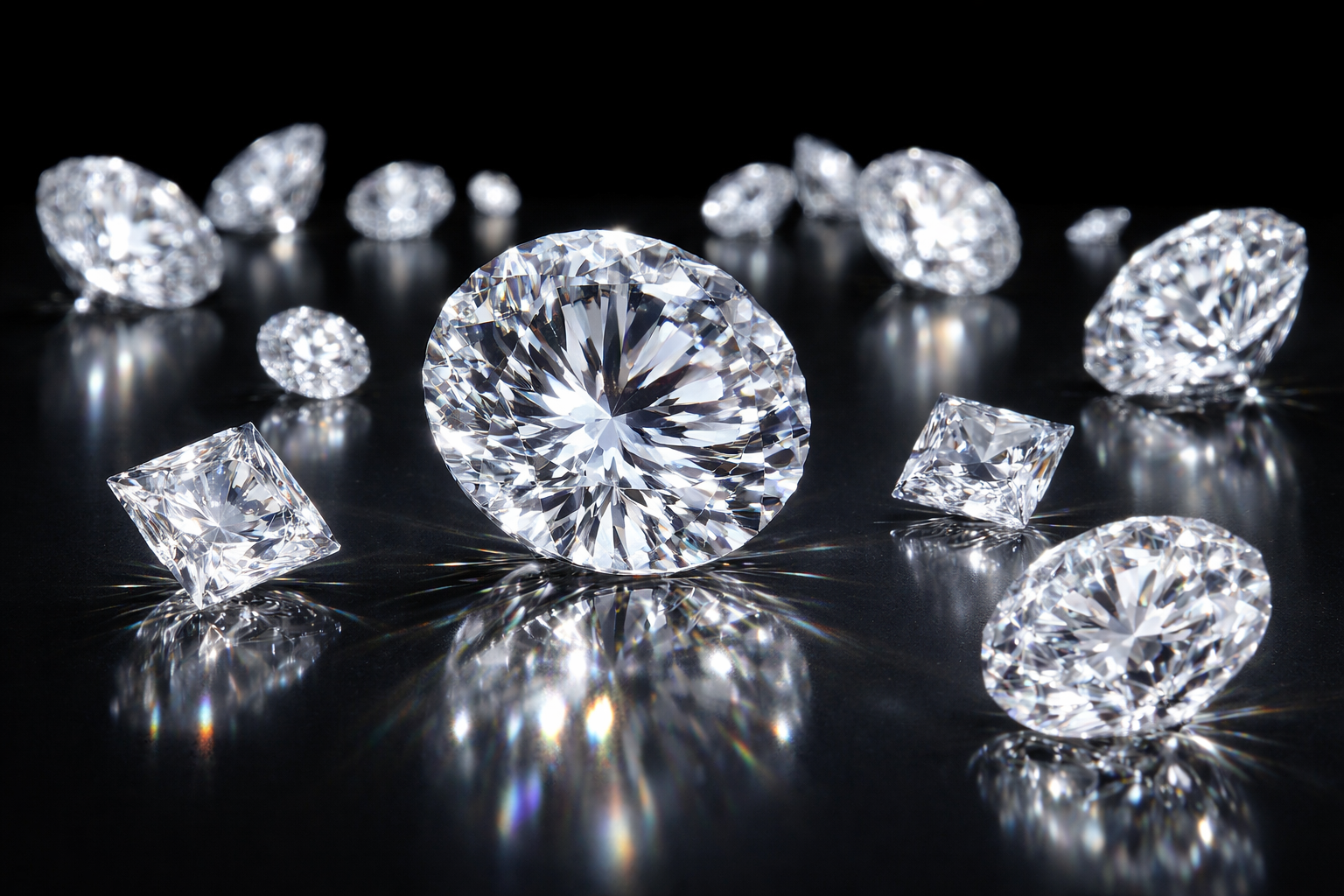
How it works: Hold the stone under a standard light source and observe how it handles light. A real diamond produces a combination of white light reflections (brilliance) and colored light flashes (fire). The brilliance should be bright and the fire should produce spectral colors -- but they should be balanced, not overwhelming.
What to look for:
- Real diamond: Strong white brilliance with moderate colored flashes. Light performance looks balanced and natural.
- Moissanite: Noticeably more fire (colored flashes) than a diamond, sometimes described as a "disco ball" effect. Under certain lighting, the rainbow flashes can appear excessive compared to diamond.
- CZ: Produces more fire than diamond but tends to look "glassy" or too perfect. The brilliance often appears duller than diamond, especially as the stone gets dirty over time.
- Glass: Very little fire, dull brilliance, and a flat, lifeless appearance.
Limitations: This test requires experience and a trained eye. The differences between diamond, moissanite, and CZ sparkle are real but subtle, especially in smaller stones. Most people without gemological training cannot make this distinction reliably.
Test 6: The Weight Test
How it works: If you have access to a precise scale (0.01 gram accuracy), weigh the loose stone and compare it against expected weights for a diamond of that size. CZ weighs about 55-70% more than a diamond of the same dimensions.
Why it works: CZ has a density of 5.6-6.0 g/cm³ compared to diamond's 3.52 g/cm³. A round brilliant CZ that measures 6.5mm across (the standard dimension for a 1-carat round diamond) would weigh approximately 1.55-1.70 carats. If your stone measures like a 1-carat diamond but weighs significantly more, it's likely CZ.
Limitations: You need the stone to be loose and you need a precise scale. Moissanite (density 3.21 g/cm³) actually weighs slightly less than diamond for the same dimensions, but the difference is so small (about 9%) that it's difficult to detect without lab equipment. This test is primarily useful for identifying CZ.
When to See a Professional
If your stone passes most of the home tests, that's encouraging -- but it's not definitive proof. You should see a professional gemologist or jeweler if:
- You're considering selling the stone and need to confirm its identity and quality
- You purchased the stone online or from a non-certified source and want verification
- You inherited jewelry and don't know what the stones are
- You suspect a stone has been switched (after a repair, for example)
- You want to distinguish between diamond and moissanite (home tests can't do this reliably)
At Diamonds Above in Austin, we offer complimentary diamond verification for anyone who walks into our showroom. Our gemologists use professional-grade equipment including:
- Dual thermal/electrical conductivity testers -- identifies diamond, moissanite, CZ, and other simulants in seconds
- 10x-60x magnification -- examines inclusions, growth patterns, and facet structure
- Spectroscopy equipment -- identifies the precise material composition of any stone
- UV fluorescence analysis -- performed in controlled conditions, far more reliable than a home blacklight
The testing takes about 5 minutes and there's never any charge or obligation. If you want a detailed written assessment, our appraisal services provide comprehensive documentation.
Not Sure If Your Diamond Is Real?
Bring it to our Austin showroom for a free, no-obligation diamond verification. Results in 5 minutes.
Moissanite vs. Diamond vs. CZ: Key Differences
Understanding the three most common transparent stones helps you know what you're looking at:
| Property | Diamond | Moissanite | Cubic Zirconia |
|---|---|---|---|
| Composition | Pure carbon | Silicon carbide | Zirconium dioxide |
| Hardness (Mohs) | 10 | 9.25 | 8.0-8.5 |
| Refractive Index | 2.42 | 2.65 | 2.15-2.18 |
| Fire (Dispersion) | 0.044 | 0.104 | 0.058-0.066 |
| Density | 3.52 g/cm³ | 3.21 g/cm³ | 5.6-6.0 g/cm³ |
| Durability | Exceptional -- lasts forever | Very good -- excellent for daily wear | Moderate -- scratches and clouds over time |
| Price (1ct equivalent) | $800-6,000+ | $200-600 | $10-30 |
| Thermal Test Result | Passes as diamond | Passes as diamond (false positive) | Fails -- identified as simulant |
Moissanite: Not a Fake, But Not a Diamond
It's important to understand that moissanite is a legitimate gemstone in its own right. It's not a "fake diamond" -- it's a different mineral with its own desirable properties. Moissanite is extremely hard (9.25 on the Mohs scale), more brilliant than diamond, and displays significantly more fire (colored light dispersion).
Many people intentionally choose moissanite for their engagement rings because of its beauty and affordability. The issue only arises when moissanite is sold as diamond, which is fraud. If you're purchasing what's represented as a diamond, always ask for a GIA or IGI certificate and verify the certificate number on the lab's website.
Cubic Zirconia: The Most Common Fake
CZ is the most widely used diamond simulant and the easiest to identify. While it can look impressive when new, CZ scratches relatively easily (hardness 8.0-8.5), absorbs oils from skin that dull its appearance over time, and weighs significantly more than diamond for the same size. Most basic diamond testers will correctly identify CZ as non-diamond.
A high-quality CZ costs under $30 for a 1-carat equivalent, compared to $800-6,000+ for a real diamond. The price difference alone makes it worthwhile to verify any diamond you're buying or have inherited.
Other Simulants to Know About
- White sapphire: A natural gemstone (hardness 9) sometimes used as a diamond alternative. It lacks the fire and brilliance of diamond, appearing somewhat glassy and flat in comparison.
- White topaz: Affordable but significantly less hard (hardness 8) and less brilliant than diamond. Scratches easily and looks dull over time.
- Glass/crystal: The lowest-quality simulant. Glass has low hardness (5-6), no fire, and dull brilliance. Very easy to identify with any of the home tests.
For a deeper understanding of diamond properties and how they're graded, explore our diamond education center. And for the full breakdown of what separates natural diamonds from lab-grown ones (both of which are real diamonds), read our lab-grown vs. mined diamond comparison.
Frequently Asked Questions
Can you tell if a diamond is real just by looking at it?
An untrained eye generally cannot tell a high-quality simulant from a real diamond by sight alone. Cubic zirconia, moissanite, and white sapphire can all look convincing at a glance. Experienced jewelers can often spot differences in brilliance and fire patterns, but for a definitive answer, professional testing with specialized equipment is recommended. Diamonds Above offers free diamond verification at our Austin showroom.
Will a diamond tester work on moissanite?
Basic thermal conductivity diamond testers will incorrectly identify moissanite as diamond because moissanite has similar thermal properties. You need a dual tester that measures both thermal and electrical conductivity to distinguish moissanite from diamond, since moissanite is electrically conductive and diamond is not. At Diamonds Above, we use professional-grade dual testers.
Is moissanite a fake diamond?
Moissanite is not a fake diamond -- it is a different gemstone with its own unique properties. Composed of silicon carbide rather than pure carbon, it has different optical characteristics including more fire than diamond. Moissanite is a legitimate gemstone choice. It only becomes problematic when misrepresented and sold as diamond.
Get Certainty About Your Stone
At-home tests are a useful starting point, but nothing replaces professional verification. At Diamonds Above in Austin, our gemologists can identify any stone in minutes using industry-standard equipment. Whether you're verifying a purchase, evaluating an inheritance, or just curious about a piece of jewelry, we're here to help.
Explore our natural diamond collection or learn more about lab-grown diamond options. Visit us at 4101 Guadalupe St, Suite 600, Austin, TX 78751 or . Call (512) 206-4156 -- Tuesday through Thursday, 11 AM to 4 PM and Friday through Saturday, 11 AM to 3 PM.